
Global income
Global Household Income Stratification
Source: Data Synthesized from the World Inequality Lab Framework — 2026 data
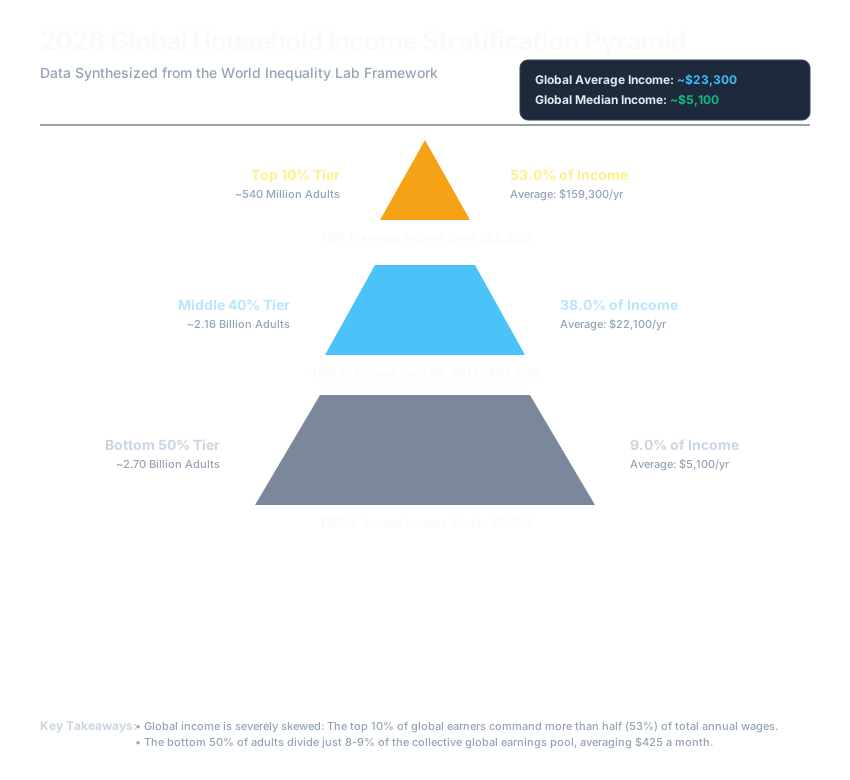
Zoom out from any single country and global income inequality dwarfs domestic inequality. Worldwide average income sits at roughly $23,300 a year, but the global median is only $5,100 — the average is more than 4.5x the median, driven entirely by the top earners.
The global top 10% earns more than half the world's income
Roughly 540 million adults — the global top 10% — earn above $65,500 a year and average $159,300, collecting 53.0% of all income earned worldwide. The middle 40%, about 2.16 billion adults earning between $5,100 and $65,500 a year (averaging $22,100), take home 38.0%. That leaves the bottom 50% — roughly 2.70 billion adults — splitting just 9.0% of global income, averaging $5,100 a year, or about $425 a month.
Where a "middle class" salary actually ranks globally
The threshold for the global top 10% — $65,500 a year — is a salary many households in high-income countries would consider solidly middle class, not wealthy. That's a useful reframe: a lot of income anxiety is relative to a local peer group, not a reflection of where that income actually sits on a global scale.
Why this matters for your RatRace Score
The RatRace Score is intentionally personal, not comparative — it measures your passive income against your own expenses, wherever you live and whatever you earn. But global context is a useful gut-check: if your income already places you in the global top 10–20%, the gap between where you are and full financial independence may be smaller than it feels day to day, and closing it is mostly a matter of directing more of that income toward passive assets rather than needing to earn dramatically more of it.
See exactly where your own income ranks with the Income Percentile Calculator.
Turn your income into passive income you can measure.
Create a free account →Home · Learn · All Charts · Why Track? · Terms · Privacy